LLM Providers
LLM providers supported by AgenticX.
LLM providers
Chat and tools go through BaseLLMProvider. First-party adapters cover major Chinese clouds; everything else can use LiteLLMProvider (OpenAI-compatible or LiteLLM model IDs).
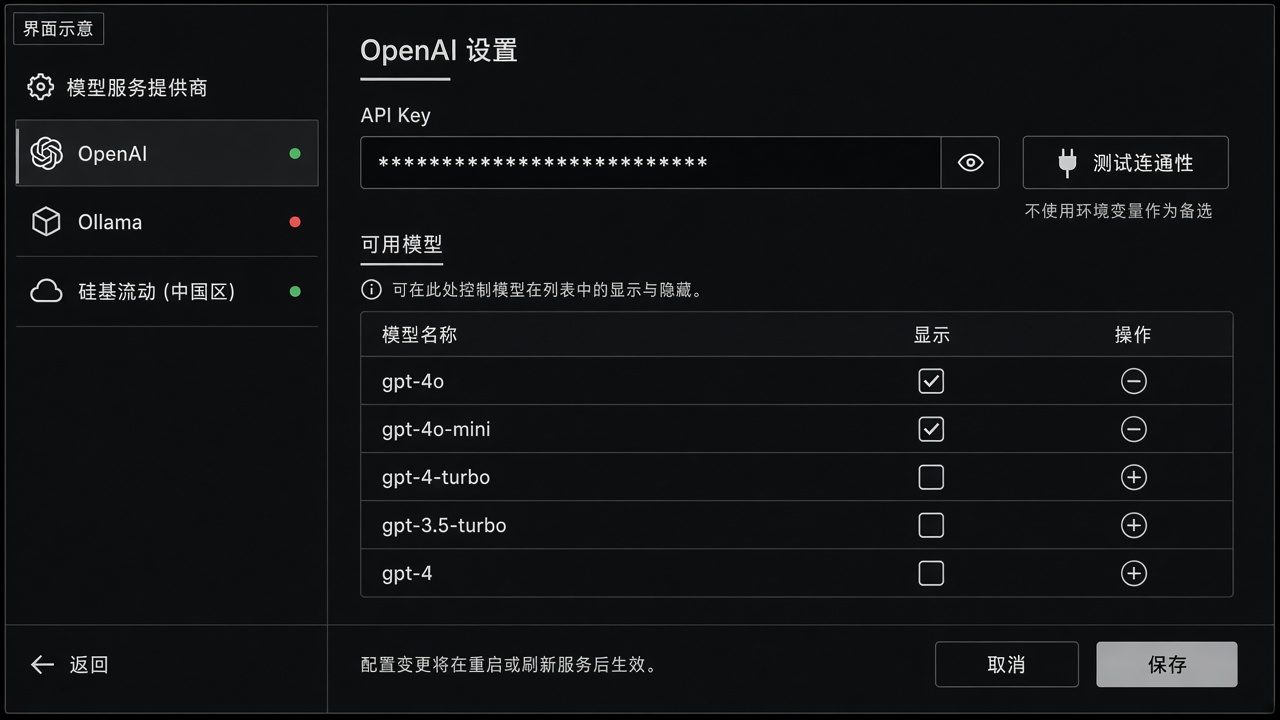
A provider is configured when an API key or a custom API base is non-empty. Leaving only the official default base does not count. Local hosts such as Ollama need a reachable API address.
Worked example: mark a provider configured
Scene. You added a key for one cloud and a custom base for a local host.
- Settings → provider list. Sidebar dots and the detail ON/OFF must agree: green only when a key or custom base is non-empty. Official default base alone stays red.
- Ollama: type a reachable API address. Empty address is not configured.
- Click 测试连通性 (one field, no extra env-var box). Fetch models opens a picker with per-row +/- visibility — it must not dump every model into the chat picker.
- Clearing the key and custom base should flip the provider off.
What you should see. Red / green only. After save, a new pane’s model pill can pick a visible model. Attaching an image to MiniMax M2 should show the in-pane warning, not a provider 400.
Supported providers
| Provider | Primary Python class | Vision | Notes |
|---|---|---|---|
| OpenAI | OpenAIProvider (LiteLLMProvider) | Yes (model-dependent) | Default stack; vision on GPT-4o-class and similar |
| Anthropic | AnthropicProvider (LiteLLMProvider) | Yes (model-dependent) | Use anthropic/ model prefix when required |
| Ollama | OllamaProvider (LiteLLMProvider) | Model-dependent | Local; typically ollama/<model> |
| Google Gemini | GeminiProvider (LiteLLMProvider) | Yes (model-dependent) | LiteLLM gemini/ IDs |
| Kimi / Moonshot | KimiProvider, MoonshotProvider | No (typical chat SKUs) | Dedicated HTTP adapter; long context |
| MiniMax | MiniMaxProvider, MinimaxProvider | No for M2* chat line | openai/ prefix applied internally; M2 family has no image/audio input |
| VolcEngine Ark | ArkLLMProvider, ArkProvider, VolcEngineProvider | Model-dependent | ByteDance Doubao / Ark endpoints |
| Zhipu GLM | ZhipuProvider, ZhiPuProvider | Yes on GLM-4V-class | Dedicated adapter |
| Baidu Qianfan | QianfanProvider, QianFanProvider | Model-dependent | May require secret_key in config |
| Alibaba Bailian / Dashscope | BailianProvider, DashscopeProvider | Model-dependent | Qwen-VL and cousins when configured |
| SiliconFlow | LiteLLMProvider | Model-dependent | Point base_url at SiliconFlow OpenAI-compatible API |
| LiteLLM (generic) | LiteLLMProvider | Model-dependent | Any LiteLLM-supported backend |
| Azure OpenAI | LiteLLMProvider | Model-dependent | azure/ models; api_version + Azure key |
| DeepSeek | LiteLLMProvider | Model-dependent | Via LiteLLM routing |
| Groq | LiteLLMProvider | Model-dependent | Via LiteLLM groq/ models |
| Mistral | LiteLLMProvider | Model-dependent | Via LiteLLM mistral/ models |
| Together AI | LiteLLMProvider | Model-dependent | Via LiteLLM |
| xAI | LiteLLMProvider | Model-dependent | Via LiteLLM |
ProviderResolver.PROVIDER_MAP wires config keys openai, anthropic, ollama, zhipu, volcengine / ark, bailian, qianfan, kimi, minimax to the classes above.
Usage
OpenAI
1from agenticx.llms import OpenAIProvider23llm = OpenAIProvider(4 model="gpt-4o",5 api_key="sk-...", # or rely on env / config6)7resp = llm.invoke("Summarize this in one line.")
Anthropic
1from agenticx.llms import AnthropicProvider23llm = AnthropicProvider(4 model="anthropic/claude-sonnet-4-20250514",5 api_key="sk-ant-...",6)7resp = llm.invoke([{"role": "user", "content": "Hello"}])
Ollama (local)
1from agenticx.llms import OllamaProvider23llm = OllamaProvider(4 model="ollama/qwen2.5:7b",5 base_url="http://127.0.0.1:11434",6)7resp = llm.invoke("Ping")
MiniMax
1from agenticx.llms import MinimaxProvider23llm = MinimaxProvider(4 model="MiniMax-M2.5",5 api_key="...",6 # base_url defaults to https://api.minimax.chat/v17)8resp = llm.invoke("Reply with OK.")
LiteLLM
1from agenticx.llms import LiteLLMProvider23# Example: third-party OpenAI-compatible endpoint (e.g. SiliconFlow)4llm = LiteLLMProvider(5 model="openai/Qwen/Qwen2.5-7B-Instruct",6 api_key="...",7 base_url="https://api.siliconflow.cn/v1",8)9resp = llm.invoke("Hello")
Auth profile rotation
AuthProfileManager (agenticx.llms.auth_profile) rotates multiple API keys (or logical profiles) for the same provider. It persists cooldown metadata to a JSON file (atomic write via .tmp then replace).
get_current()— picks the next usable profile (available first, ordered bylast_used; cooling profiles queued bycooldown_until).mark_success(profile_name)— clears error state and cooldown timestamps for that profile.mark_failure(profile_name, failure_type)— incrementserror_count, setsfailure_type, and applies exponential backoff tocooldown_until.classify_failure(exc)— maps exceptions tobilling,auth,rate_limit, orotherusing message heuristics.
Backoff (implemented in _compute_cooldown_ms):
| Failure bucket | Base | Cap | Multiplier per step |
|---|---|---|---|
billing | 5 hours | 24 hours | 2 ** min(error_count - 1, 10) |
rate_limit, auth, other, … | 60 seconds | 1 hour | 5 ** min(error_count - 1, 3) |
BaseLLMProvider.invoke_with_profile(messages, api_key=...) forwards to invoke(..., api_key=api_key) so callers can inject the rotated secret without replacing the provider instance.
Failover routing
FailoverProvider wraps two providers: a primary and a fallback. For each of invoke, ainvoke, stream, astream, and stream_with_tools, it tries the primary unless the primary is in cooldown.
failure_threshold(default3) — consecutive primary failures before entering cooldown.cooldown_duration(default60seconds) — primary bypass window after the threshold is hit.- A successful primary call resets the failure counter and clears cooldown.
1from agenticx.llms import FailoverProvider, OpenAIProvider, AnthropicProvider23llm = FailoverProvider(4 primary=OpenAIProvider(model="gpt-4o", api_key="..."),5 fallback=AnthropicProvider(model="anthropic/claude-sonnet-4-20250514", api_key="..."),6 failure_threshold=3,7 cooldown_duration=120.0,8)
Response cache
ResponseCache is an in-memory store keyed by SHA-256 (truncated) of the string prompt. Entries carry a TTL (ttl_seconds, default 300) and LRU eviction (max_entries, default 100). It is not wired automatically into LiteLLMProvider; wrap calls when you want cheaper dev loops.
1from agenticx.llms import OpenAIProvider, ResponseCache23llm = OpenAIProvider(model="gpt-4o-mini", api_key="...")4cache = ResponseCache(ttl_seconds=300, max_entries=100)56def cached_invoke(text: str):7 hit = cache.get(text)8 if hit is not None:9 return hit10 out = llm.invoke(text)11 cache.put(text, out)12 return out
stats() exposes hits, misses, size, and hit rate.
Transcript sanitizer
Before model calls, agent_runtime runs _sanitize_context_messages on chat history. The pipeline is provider-aware in the broader sense that it enforces valid assistant / tool message chains so upstream APIs do not see orphaned tool rows or dangling tool_calls.
Behavior (simplified):
toolmessages are kept only when theirtool_call_idappears on a preceding assistanttool_callslist that is fully satisfied by contiguous tool responses.- Assistant messages with
tool_callsare kept only when every call id has a matching tool response in history; otherwisetool_callsare stripped and text content is preserved.
This reduces provider 400 errors from broken tool loops after edits, retries, or partial persistence.
Vision and image input
Multimodal content is honored when the backend and model support it. MiniMax's M2 chat family (including M2, M2.1, M2.5, M2.7 and *-highspeed SKUs; excluding ids containing vl / vision) does not accept image or audio input per vendor constraints.
Studio strips image_inputs for those models before the completion request. Prefer a vision-capable model if attachments must reach the LLM.
Provider configuration (environment variables)
Values below are the ones AgenticX's config loader commonly pairs with providers.<name> in ~/.agenticx/config.yaml. LiteLLM may read additional variables depending on the model id.
| Variable | Used for |
|---|---|
OPENAI_API_KEY | OpenAI |
OPENAI_API_BASE | OpenAI-compatible override (optional) |
ANTHROPIC_API_KEY | Anthropic |
ANTHROPIC_API_BASE | Anthropic base URL override (optional) |
ZHIPU_API_KEY | Zhipu |
ARK_API_KEY | VolcEngine Ark (volcengine / ark provider) |
VOLCENGINE_ACCESS_KEY, VOLCENGINE_SECRET_KEY | Alternate Ark / Volcengine auth paths |
DASHSCOPE_API_KEY | Alibaba Bailian / Dashscope |
QIANFAN_ACCESS_KEY | Baidu Qianfan (secret_key often set in YAML) |
MOONSHOT_API_KEY | Kimi / Moonshot |
MINIMAX_API_KEY | MiniMax |
AGX_MAX_TOOL_ROUNDS | Runtime cap on tool rounds (global) |
AGX_CHROMIUM_QUIET | Desktop Chromium log noise (optional) |
Ollama is usually configured with base_url in YAML (for example http://localhost:11434); keys are not required for local inference.