Agent Runtime
Agent runtime execution in AgenticX.
Agent runtime
This page describes the AgentRuntime execution path (agenticx/runtime/agent_runtime.py): think-act loop, event stream, timeouts, confirmation gates, compaction, loop detection, and hooks. It is distinct from AgentExecutor in agenticx/core/agent_executor.py.
Use AgentRuntime for Studio / Near chat. Use AgentExecutor to embed Agent + Task in your own process. Do not pass agent= into the AgentExecutor constructor.
Worked example: one Near turn
Scene. “Extract the first two sections of README.”
- In a Meta pane, attach the README with
@file(absolutesourcePath). - Send the request. Studio streams SSE events; the renderer should show a Thinking / Thought block if the model emits
<think>, then a folded tool card (liteparseorfile_read), then the final text. - If the tool sequence is broken (assistant
tool_callswithout matchingtoolrows),_sanitize_context_messagesdrops the orphans before the next provider call — you should not see a raw HTTP 400 in the bubble.
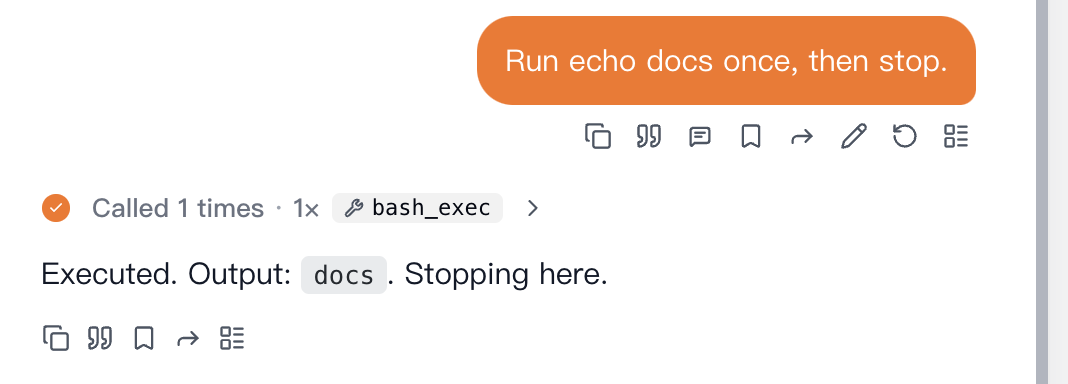
What you should see. Spinner + “Thinking” in the same bubble, then a collapsed Thought. A tool card aligned with the assistant bubble. No duplicated streamed paragraphs. You can scroll up while tokens still arrive.
On the SDK path the same job is AgentExecutor(llm_provider=...).run(agent=, task=). That path has no SSE and no Near tool cards.
Agent definition (Agent model)
The primary agent record is agenticx.core.agent.Agent (Pydantic BaseModel). Fields commonly used for persona and tenancy:
| Field | Type | Notes | |
|---|---|---|---|
id | str | Defaults to a new UUID if omitted. | |
name | str | Display name. | |
role | str | Role description for prompts. | |
goal | str | Primary objective. | |
backstory | `str | None` | Optional persona context. |
organization_id | str | Multi-tenant namespace; default "default-org". |
The model also carries tools, LLM hooks, max_iterations (default 25), max_retry_limit, and related configuration. There is no verbose boolean on Agent, and there is no field named max_iter—iteration limits for the runtime tool loop are configured separately.
Running an agent (AgentExecutor)
agenticx.core.agent_executor.AgentExecutor is the control-flow engine for Agent + Task: it builds prompts, calls the configured BaseLLMProvider, parses actions, runs BaseTool instances (including parallel batches), applies GuideRails, and can compact context via ContextCompiler.maybe_compact on an internal event log.
Typical usage:
1from agenticx.core.agent import Agent2from agenticx.core.agent_executor import AgentExecutor3from agenticx.core.task import Task4from agenticx.llms import OpenAIProvider56agent = Agent(7 name="Research Assistant",8 role="Analyst",9 goal="Summarize findings",10 organization_id="my-org",11)12task = Task(13 id="t1",14 description="Research topic X",15 expected_output="Short report",16)17executor = AgentExecutor(llm_provider=OpenAIProvider(model="gpt-4o"))18result = executor.run(agent=agent, task=task)
AgentExecutor.__init__ accepts max_iterations (default 50), independent of Agent.max_iterations.
The think-act loop (AgentRuntime.run_turn)
Each user turn runs AgentRuntime.run_turn, which loops at most max_tool_rounds times. One round is:
- Message sanitization —
_sanitize_context_messagesrepairs history so everyassistantmessage withtool_callsis followed by matchingtoolrows (bytool_call_id). Orphan tool rows and danglingtool_callsare dropped so providers do not return HTTP 400 on broken sequences. - Context compaction —
ContextCompactor.maybe_compactmay replace older history with a singlesystemsummary message. On success, aCOMPACTIONevent is emitted andon_compactionhooks run. - LLM call — If
llm.stream_with_toolsexists and succeeds, the runtime streams content and tool_call_delta chunks in a worker thread, enforces first-feedback, invoke, heartbeat, and hard timeouts, normalizes invalid tool names (e.g."None"), and repairs streamed JSON arguments. On any failure, it falls back tollm.invokewithtools,tool_choice="auto".run_before_model/run_after_modelhooks wrap the call. - Tool-call filtering — Parsed
tool_callsdrop empty names andname.lower() == "none". If the model returns no native tool calls, the runtime may extract an inline tool call from plaintext when it matches the allowed tool set. - Tool dispatch — For each call:
run_before_tool_callmay block. Unknown tools and invalid names produceTOOL_RESULT(and oftenERROR) without executing. Tools in_meta_only_namesgo throughdispatch_meta_tool_async(requiresteam_manager); all others usedispatch_tool_asyncwith the runtimeconfirm_gate. Nested tool events from the dispatcher are re-yielded asRuntimeEvents. - Loop detection — After each executed tool,
LoopDetector.record_call/checkrun. Warning level injects a user-role reminder intomessages; critical level emitsERRORand ends the turn.
If the model returns text and no tools, the runtime streams final text if needed, runs run_on_agent_end, yields FINAL, and returns. If max_tool_rounds is exhausted without a final answer, meta agents get ERROR; non-meta agents get SUBAGENT_PAUSED with checkpoint metadata.
Runtime event stream (EventType)
agenticx/runtime/events.py defines the string enum consumed by Studio and tests:
EventType | Value | Role |
|---|---|---|
ROUND_START | round_start | New tool round; payload includes round, max_rounds. |
TOKEN | token | Streamed model text (or first-idle waiting pulse from the runtime). |
TOOL_CALL | tool_call | Tool name, arguments, tool_call_id. |
TOOL_RESULT | tool_result | Tool output string (including synthetic errors for blocked/unknown tools). |
CONFIRM_REQUIRED | confirm_required | Emitted when a tool asks for confirmation and an event callback is wired. |
CONFIRM_RESPONSE | confirm_response | Emitted after the gate resolves with approved boolean. |
COMPACTION | compaction | History was compacted; includes compacted_count, summary. |
SUBAGENT_CHECKPOINT | subagent_checkpoint | Periodic progress for non-meta agents (every 8 rounds). |
SUBAGENT_PAUSED | subagent_paused | Sub-agent hit max rounds without finishing. |
FINAL | final | Terminal natural-language reply for the turn. |
ERROR | error | Failure, user stop, timeout, or loop guard abort. |
SUBAGENT_STARTED | subagent_started | Delegation started (e.g. meta tools / team manager). |
SUBAGENT_PROGRESS | subagent_progress | Mid-run subagent updates. |
SUBAGENT_COMPLETED | subagent_completed | Subagent finished successfully. |
SUBAGENT_ERROR | subagent_error | Subagent failed. |
Timeout configuration
Resolved in agent_runtime.py via environment variables. Values are seconds.
| Variable | Default | Role |
|---|---|---|
AGX_LLM_INVOKE_TIMEOUT_SECONDS | 120 | Idle budget before the first streamed chunk (streaming) or total wait for invoke completion (non-streaming path). |
AGX_LLM_HEARTBEAT_TIMEOUT_SECONDS | 60 | Max idle time between streamed chunks after the first chunk. |
AGX_LLM_HARD_TIMEOUT_SECONDS | 300 | Wall-clock cap for the streaming worker; stops the stream when exceeded. |
AGX_LLM_FIRST_FEEDBACK_SECONDS | 8 | After this delay with no first chunk, the runtime may emit a short waiting TOKEN. |
The LLM request timeout passed into providers is derived as max(invoke, heartbeat, hard) + 15 seconds.
Confirm gate
| Class | Behavior |
|---|---|
ConfirmGate | Abstract request_confirm(question, context) -> bool. |
SyncConfirmGate | Blocking input(); for CLI. |
AsyncConfirmGate | Publishes a pending Future; server/UI resolves via resolve(request_id, approved). Emits confirm_required / confirm_response when an event callback is used. |
AutoApproveConfirmGate | Always returns True; used e.g. for delegated sub-agents that must not block on human input. last_request stays unset. |
Run Everything (Desktop permission mode auto) means the product treats risky operations as pre-approved for that session: confirmations should resolve without repeated prompts, consistent with auto-approval policy.
Context compaction
ContextCompactor.maybe_compact (agenticx/runtime/compactor.py):
- Triggers when history length >
threshold_messages(default 20, minimum 8) or total character count >threshold_chars(default 48,000). - Keeps the last
retain_recent_messagesmessages (default 8, minimum 4). - Summarizes the prefix via
llm.invokeon a Chinese prompt; on failure, falls back to truncated snippets. - Returns a list starting with one
systemmessage tagged[compacted] ...plus retained tail messages.
Loop detection
LoopDetector (agenticx/runtime/loop_detector.py) tracks recent (tool_name, args_signature) pairs and progress marks.
AgentRuntime constructs it with warning_threshold=4 and critical_threshold=8 (constructor arguments). Detectors include:
- generic_repeat — same tool + same arguments repeated.
- ping_pong — alternating pattern on the tail.
- no_progress — many calls without artifacts/scratchpad progress or other heuristics.
Warning adds a reminder message; critical stops the run with ERROR.
Runtime configuration
| Variable / knob | Default (Studio server) | Meaning |
|---|---|---|
AGX_MAX_TOOL_ROUNDS / runtime.max_tool_rounds | 30 if unset (clamped 10–120 in studio/server.py) | Max think-act rounds per user message. Bare AgentRuntime() uses Python default 10 unless overridden. |
AGX_STATUS_QUERY_BUDGET_PER_TURN | 2 | Meta-agent budget for query_subagent_status per turn. |
AGX_STATUS_QUERY_COOLDOWN_SECONDS | 8 | Minimum spacing between status queries for meta. |
Events hook (HookRegistry / AgentHook)
Registered hooks (agenticx/runtime/hooks/__init__.py) run in priority order:
| Hook | When |
|---|---|
before_model | After compaction/sanitization assembly, immediately before the LLM call. May replace the message list. |
after_model | After a successful LLM response object is produced. |
before_tool_call | Before dispatch; may block with a reason (synthetic tool error). |
after_tool_call | May rewrite the tool result string. |
on_compaction | After a successful compaction (mirrors COMPACTION event). |
on_agent_end | Immediately before emitting FINAL, or when ending with max-round messages. |
AgentRuntime registers MemoryHook at low priority when available.
Related
- Orchestration — multi-step workflows and coordination.
- Tools — tool definitions and dispatch.
- Memory — long-horizon recall and hooks.