智能体运行时
AgenticX 智能体运行时执行。
智能体运行时
本页描述 `AgentRuntime` 执行路径(agenticx/runtime/agent_runtime.py):think-act 循环、事件流、超时、确认门控、压缩、循环检测与钩子。它与 agenticx/core/agent_executor.py 里的 `AgentExecutor` 不同。
Studio / Near 对话走 AgentRuntime。自己进程里嵌 Agent + Task 走 AgentExecutor。不要把 agent= 传给 AgentExecutor 构造函数。
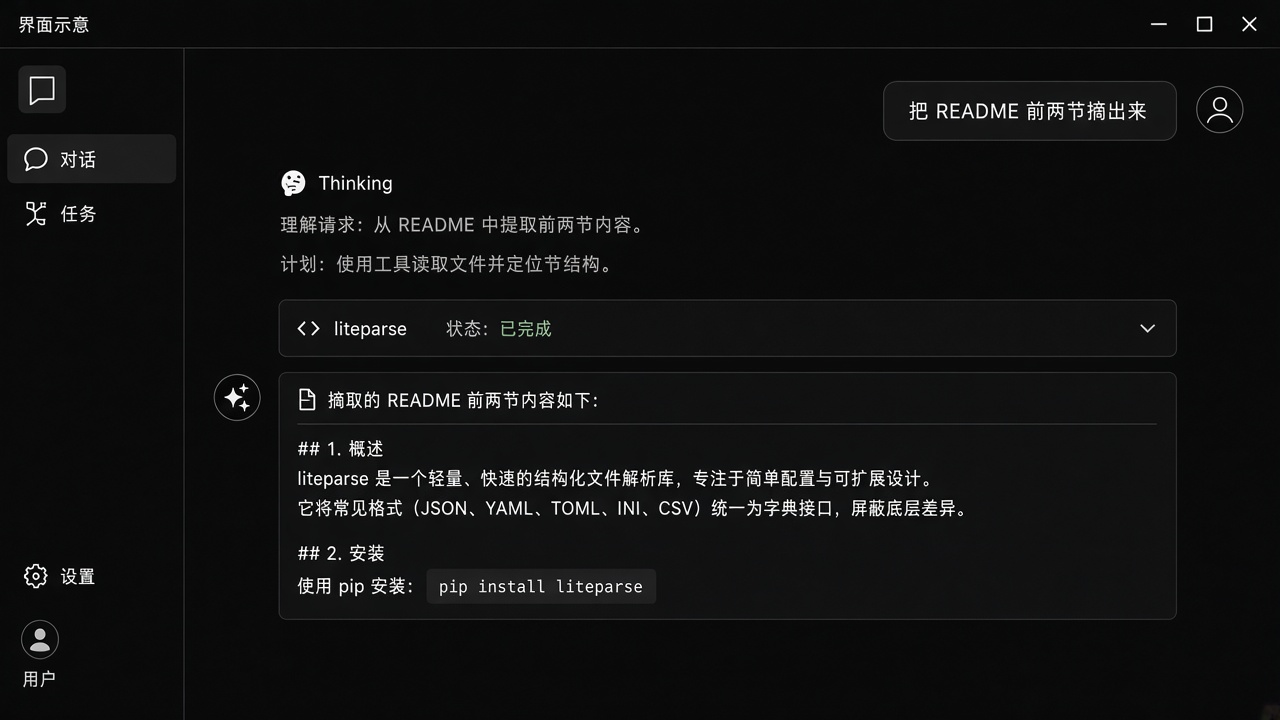
实践案例:Near 里的一轮
场景。 「把 README 前两节摘出来。」
- 在 Meta 窗格用
@file挂上 README(绝对sourcePath)。 - 发送。Studio 走 SSE;若模型输出
<think>,应先出现 Thinking / Thought,再是折叠的工具卡(liteparse或file_read),最后才是正文。 - 若历史里
assistant(tool_calls)缺对应tool行,_sanitize_context_messages会在下次请求前丢掉断链,气泡里不应直接甩 HTTP 400。
你会看到。 同一气泡里的 spinner + Thinking,完成后折成 Thought。工具卡和助手气泡对齐。流式过程中可以上滚,且不应整段重复拼接。
SDK 路径同一件事是 AgentExecutor(llm_provider=...).run(agent=, task=)。那条路没有 SSE,也没有 Near 工具卡。
智能体定义(`Agent` 模型)
主智能体记录为 agenticx.core.agent.Agent(Pydantic BaseModel)。常用于人设与租户的字段:
| Field | Type | Notes | |
|---|---|---|---|
id | str | Defaults to a new UUID if omitted. | |
name | str | Display name. | |
role | str | Role description for prompts. | |
goal | str | Primary objective. | |
backstory | `str | None` | Optional persona context. |
organization_id | str | Multi-tenant namespace; default "default-org". |
模型还携带 tools、LLM hooks、max_iterations(默认 25)、max_retry_limit 等配置。Agent 上 没有 verbose 布尔字段,也 没有 名为 max_iter 的字段——运行时工具循环 的迭代上限需单独配置。
运行智能体(`AgentExecutor`)
agenticx.core.agent_executor.AgentExecutor 是 `Agent` + `Task` 的控制流引擎:构建提示、调用配置的 BaseLLMProvider、解析动作、运行 BaseTool 实例(含并行批次)、应用 GuideRails,并可通过内部事件日志上的 `ContextCompiler.maybe_compact` 压缩上下文。
典型用法:
1from agenticx.core.agent import Agent2from agenticx.core.agent_executor import AgentExecutor3from agenticx.core.task import Task4from agenticx.llms import OpenAIProvider56agent = Agent(7 name="Research Assistant",8 role="Analyst",9 goal="Summarize findings",10 organization_id="my-org",11)12task = Task(13 id="t1",14 description="Research topic X",15 expected_output="Short report",16)17executor = AgentExecutor(llm_provider=OpenAIProvider(model="gpt-4o"))18result = executor.run(agent=agent, task=task)
AgentExecutor.__init__ 接受 max_iterations(默认 50),与 Agent.max_iterations 独立。
Think-act 循环(`AgentRuntime.run_turn`)
每个用户轮次运行 `AgentRuntime.run_turn`,最多循环 `max_tool_rounds` 次。一轮包括:
- 消息清洗 —
_sanitize_context_messages修复历史,使每个带tool_calls的assistant消息后紧跟匹配的tool行(按tool_call_id)。孤立 tool 行与悬空tool_calls会被丢弃,避免 provider 因序列断裂返回 HTTP 400。 - 上下文压缩 —
ContextCompactor.maybe_compact可能用单一system摘要消息替换较早历史。成功时发出 `COMPACTION` 事件并运行 `on_compaction` 钩子。 - LLM 调用 — 若
llm.stream_with_tools存在且成功,运行时在 worker 线程中流式输出 content 与 tool_call_delta chunk,强制执行 first-feedback、invoke、heartbeat、hard 超时,规范化无效工具名(如"None")并修复流式 JSON 参数。任何失败时 回退 到带tools、tool_choice="auto"的 `llm.invoke`。`run_before_model` / `run_after_model` 钩子包裹调用。 - 工具调用过滤 — 解析的
tool_calls丢弃空名与name.lower() == "none"。若模型未返回原生 tool call,运行时可从纯文本提取 inline tool call(当匹配允许工具集时)。 - 工具分发 — 每次调用:`run_before_tool_call` 可阻塞。未知工具与无效名产生 `TOOL_RESULT`(常伴随 `ERROR`)但不执行。`_meta_only_names` 中的工具走 `dispatch_meta_tool_async`(需
team_manager);其余通过运行时 `confirm_gate` 使用 `dispatch_tool_async`。分发器嵌套工具事件会 re-yield 为 `RuntimeEvent`。 - 循环检测 — 每次工具执行后运行 `LoopDetector.record_call` / `check`。Warning 级别向
messages注入 user 角色提醒;critical 级别发出 `ERROR` 并结束本轮。
若模型返回文本且无工具,运行时按需流式输出最终文本,运行 `run_on_agent_end`,yield `FINAL` 并返回。若 `max_tool_rounds` 耗尽仍无最终答案,meta 智能体得到 `ERROR`;非 meta 智能体得到带 checkpoint 元数据的 `SUBAGENT_PAUSED`。
运行时事件流(`EventType`)
agenticx/runtime/events.py 定义 Studio 与测试消费的字符串枚举:
EventType | Value | Role |
|---|---|---|
ROUND_START | round_start | New tool round; payload includes round, max_rounds. |
TOKEN | token | Streamed model text (or first-idle waiting pulse from the runtime). |
TOOL_CALL | tool_call | Tool name, arguments, tool_call_id. |
TOOL_RESULT | tool_result | Tool output string (including synthetic errors for blocked/unknown tools). |
CONFIRM_REQUIRED | confirm_required | Emitted when a tool asks for confirmation and an event callback is wired. |
CONFIRM_RESPONSE | confirm_response | Emitted after the gate resolves with approved boolean. |
COMPACTION | compaction | History was compacted; includes compacted_count, summary. |
SUBAGENT_CHECKPOINT | subagent_checkpoint | Periodic progress for non-meta agents (every 8 rounds). |
SUBAGENT_PAUSED | subagent_paused | Sub-agent hit max rounds without finishing. |
FINAL | final | Terminal natural-language reply for the turn. |
ERROR | error | Failure, user stop, timeout, or loop guard abort. |
SUBAGENT_STARTED | subagent_started | Delegation started (e.g. meta tools / team manager). |
SUBAGENT_PROGRESS | subagent_progress | Mid-run subagent updates. |
SUBAGENT_COMPLETED | subagent_completed | Subagent finished successfully. |
SUBAGENT_ERROR | subagent_error | Subagent failed. |
超时配置
在 `agent_runtime.py` 中通过环境变量解析。单位为 秒。
| Variable | Default | Role |
|---|---|---|
AGX_LLM_INVOKE_TIMEOUT_SECONDS | 120 | Idle budget before the first streamed chunk (streaming) or total wait for `invoke` completion (non-streaming path). |
AGX_LLM_HEARTBEAT_TIMEOUT_SECONDS | 60 | Max idle time between streamed chunks after the first chunk. |
AGX_LLM_HARD_TIMEOUT_SECONDS | 300 | Wall-clock cap for the streaming worker; stops the stream when exceeded. |
AGX_LLM_FIRST_FEEDBACK_SECONDS | 8 | After this delay with no first chunk, the runtime may emit a short waiting `TOKEN`. |
传入 provider 的 LLM 请求超时 derived 为 `max(invoke, heartbeat, hard) + 15` 秒。
确认门控
| Class | Behavior |
|---|---|
| `ConfirmGate` | Abstract request_confirm(question, context) -> bool. |
| `SyncConfirmGate` | Blocking `input()`; for CLI. |
| `AsyncConfirmGate` | Publishes a pending Future; server/UI resolves via `resolve(request_id, approved)`. Emits `confirm_required` / `confirm_response` when an event callback is used. |
| `AutoApproveConfirmGate` | Always returns `True`; used e.g. for delegated sub-agents that must not block on human input. `last_request` stays unset. |
Run Everything(Desktop 权限模式 `auto`)表示产品将会话内高风险操作视为预批准:确认应无重复弹窗地 resolve,与自动批准策略一致。
上下文压缩
`ContextCompactor.maybe_compact`(agenticx/runtime/compactor.py):
- 当历史长度 > `threshold_messages`(默认 20,最小 8)或 总字符数 > `threshold_chars`(默认 48,000)时触发。
- 保留最后 `retain_recent_messages` 条消息(默认 8,最小 4)。
- 通过中文提示上的 `llm.invoke` 摘要前缀;失败时回退为截断片段。
- 返回以一条带
[compacted] ...标签的 `system` 消息开头、外加保留尾部消息的列表。
循环检测
`LoopDetector`(agenticx/runtime/loop_detector.py)跟踪近期 (tool_name, args_signature) 对与进度标记。
`AgentRuntime` 以 `warning_threshold=4` 与 `critical_threshold=8`(构造参数)实例化。检测器包括:
- generic_repeat — 相同工具 + 相同参数重复。
- ping_pong — 尾部交替模式。
- no_progress — 多次调用无 artifact/scratchpad 进度等启发式。
Warning 添加提醒消息;critical 以 `ERROR` 停止运行。
运行时配置
| Variable / knob | Default (Studio server) | Meaning |
|---|---|---|
AGX_MAX_TOOL_ROUNDS / runtime.max_tool_rounds | 30 if unset (clamped 10–120 in studio/server.py) | Max think-act rounds per user message. Bare `AgentRuntime()` uses Python default 10 unless overridden. |
AGX_STATUS_QUERY_BUDGET_PER_TURN | 2 | Meta-agent budget for `query_subagent_status` per turn. |
AGX_STATUS_QUERY_COOLDOWN_SECONDS | 8 | Minimum spacing between status queries for meta. |
事件钩子(`HookRegistry` / `AgentHook`)
已注册钩子(agenticx/runtime/hooks/__init__.py)按优先级顺序运行:
| Hook | When |
|---|---|
| `before_model` | After compaction/sanitization assembly, immediately before the LLM call. May replace the message list. |
| `after_model` | After a successful LLM response object is produced. |
| `before_tool_call` | Before dispatch; may `block` with a reason (synthetic tool error). |
| `after_tool_call` | May rewrite the tool result string. |
| `on_compaction` | After a successful compaction (mirrors `COMPACTION` event). |
| `on_agent_end` | Immediately before emitting `FINAL`, or when ending with max-round messages. |
AgentRuntime 在可用时以低优先级注册 `MemoryHook`。